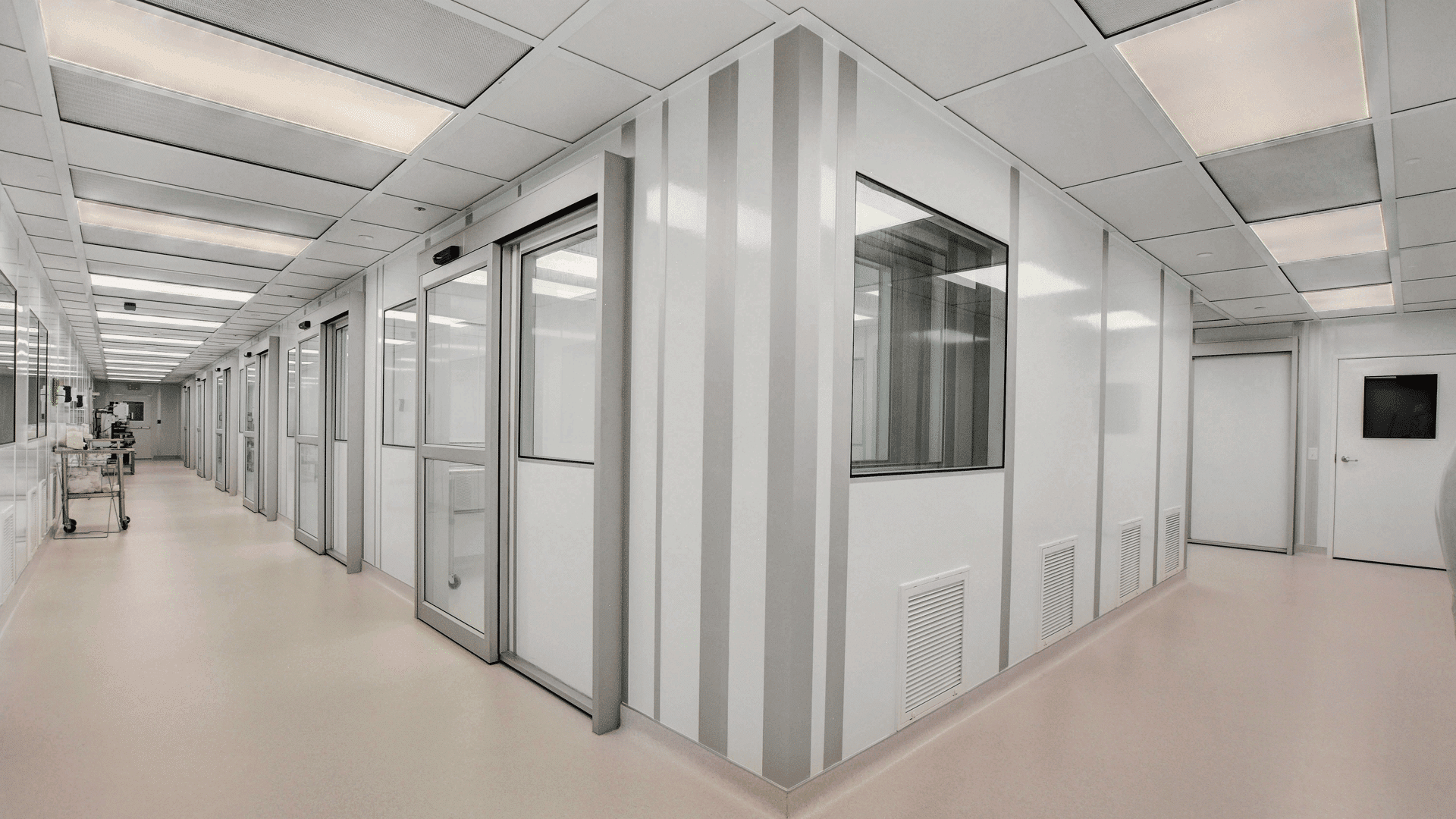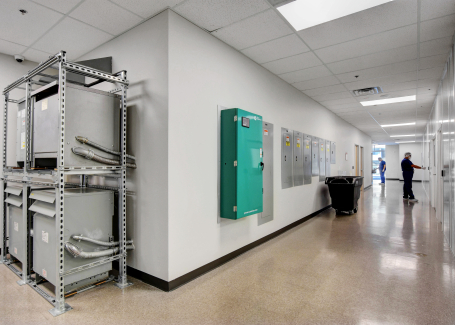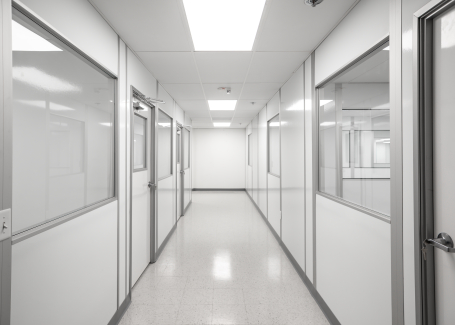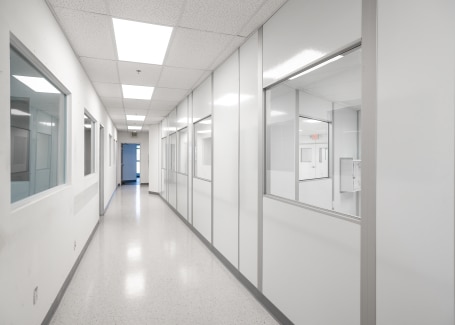

At first glance, cleanrooms and their related classifications appear to be impossible to understand. Most people are scared away by the technical language, thinking that only an engineer could make sense of it. But the truth is that it’s very simple. Fundamentally, cleanrooms place limits on the size and number of particles in the air. These particles are the “contaminants” that cleanrooms keep out. The main difference between each classification (from ISO Class 1 to ISO Class 9) is the number and size of particles allowed. That’s it.
In this article, we’ll make ISO 5 cleanrooms easy to understand, and discuss their characteristics, requirements, applications, and more.
What is an ISO 5 Cleanroom?
According to ISO 14644-1, an ISO 5 cleanroom is a controlled environment that restricts particles to 3,520 maximum per cubic meter of air (at 0.5 micrometers or larger). To reach this level of cleanliness, they generally require 240 to 600 air changes per hour, as well as unidirectional airflow, which makes them generally more expensive than ISO 6 and lower classifications.
In each cubic meter of air, they allow up to:
- 100,000 particles for sizes 0.1 micrometers or larger.
- 23,700 particles for sizes 0.2 micrometers or larger.
- 10,200 particles for sizes 0.3 micrometers or larger.
- 3,520 particles for sizes 0.5 micrometers or larger.
- 832 particles for sizes 1 micrometer or larger.
- 29 particles for sizes 5 micrometers or larger.
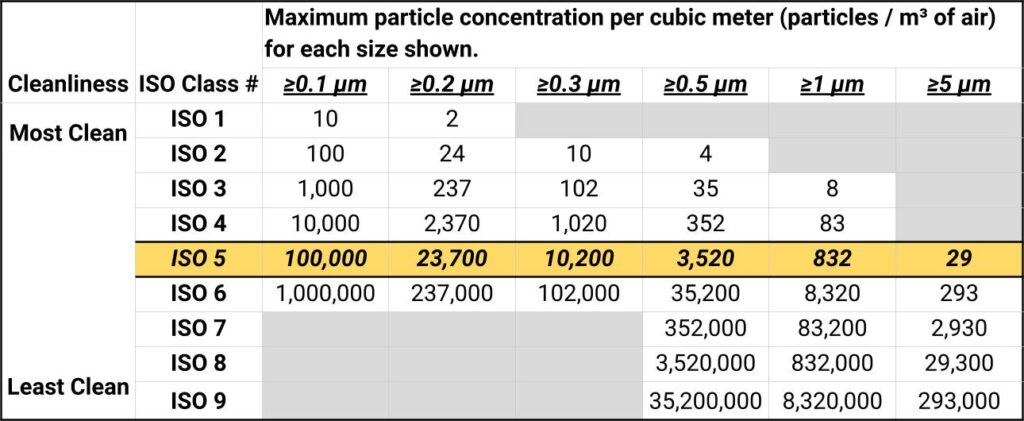
The list above represents the maximum number of particles for each given size. It’s important to keep in mind that the listed maximum particle counts build on one another. This means that a single 6-micrometer particle counts towards the limit for particles over 5 micrometers, as well as for all the lower size limits.
ISO Class 5 cleanrooms permit fewer airborne particles than ISO 6–9 classifications, making them “cleaner.” On the other hand, ISO 4 and below are stricter, and they permit even fewer particles.
Is an ISO Class 5 Cleanroom the Same as a Class 100 Cleanroom?
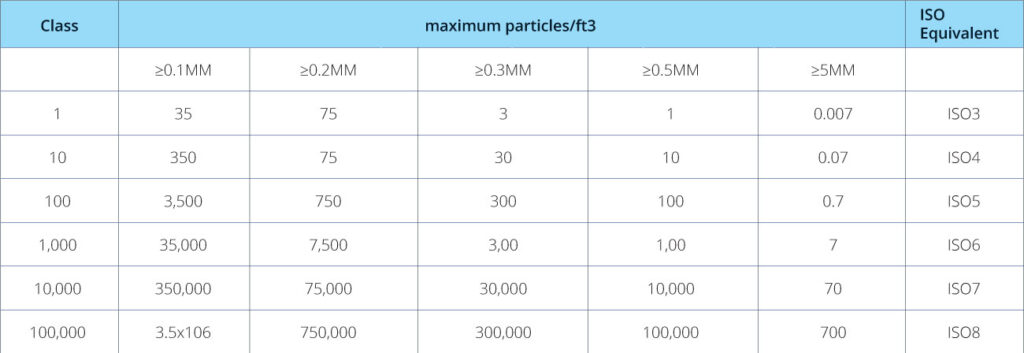
ISO Class 5 cleanrooms are functionally the same as Class 100 cleanrooms. The latter classification was part of the Federal Standard 209E, which isn’t used any longer, and defined cleanrooms by particles per cubic foot, rather than cubic meter.
Specifically, Class 100 cleanrooms allowed a maximum of 100 particles larger than 0.5 microns per cubic foot of air, hence the “100” in Class 100.
As said before, the current ISO 14644-1 standard counts particles per cubic meter. However, “ISO 5” and “Class 100” are still used interchangeably by many.
ISO 5 Cleanroom Requirements
Though they are in the middle range for cleanliness, these cleanrooms still require a lot of advanced features, even more so than less strict classifications.
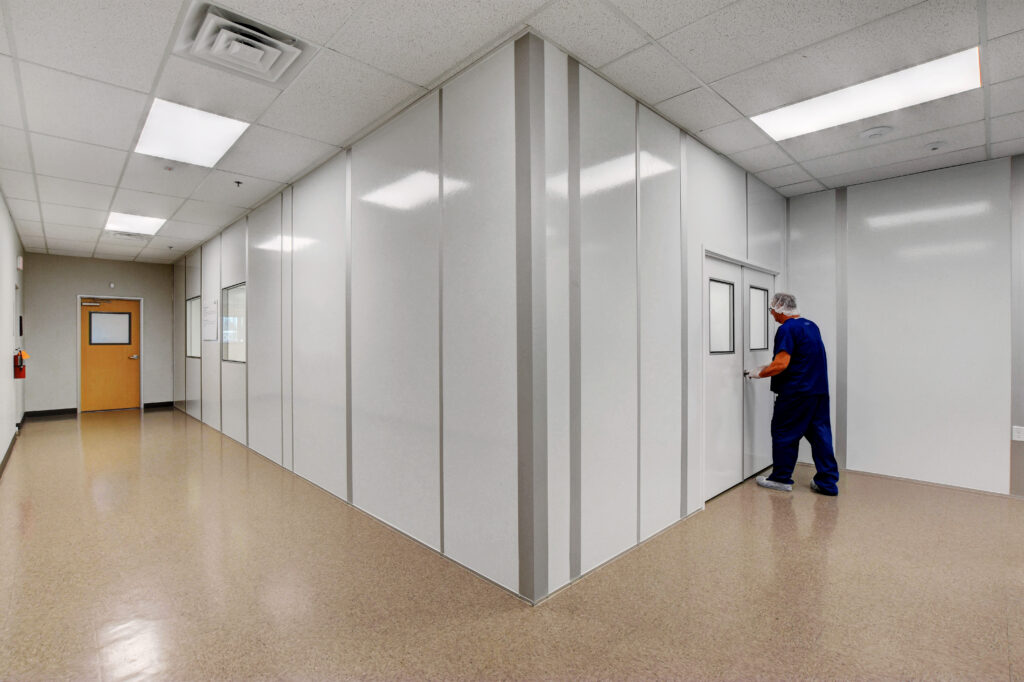
Generally, achieving an ISO 5 environment requires a progression through cleaner spaces. The process typically begins in an ISO 8 cleanroom. There, you progress through ISO 7 and ISO 6 cleanrooms before finally entering the ISO 5 space. (You may also use airlocks to achieve this in fewer steps, but it is not always recommended.)
The purpose of this is to keep your cleanroom free of as many unwanted particles as possible.
Airflow
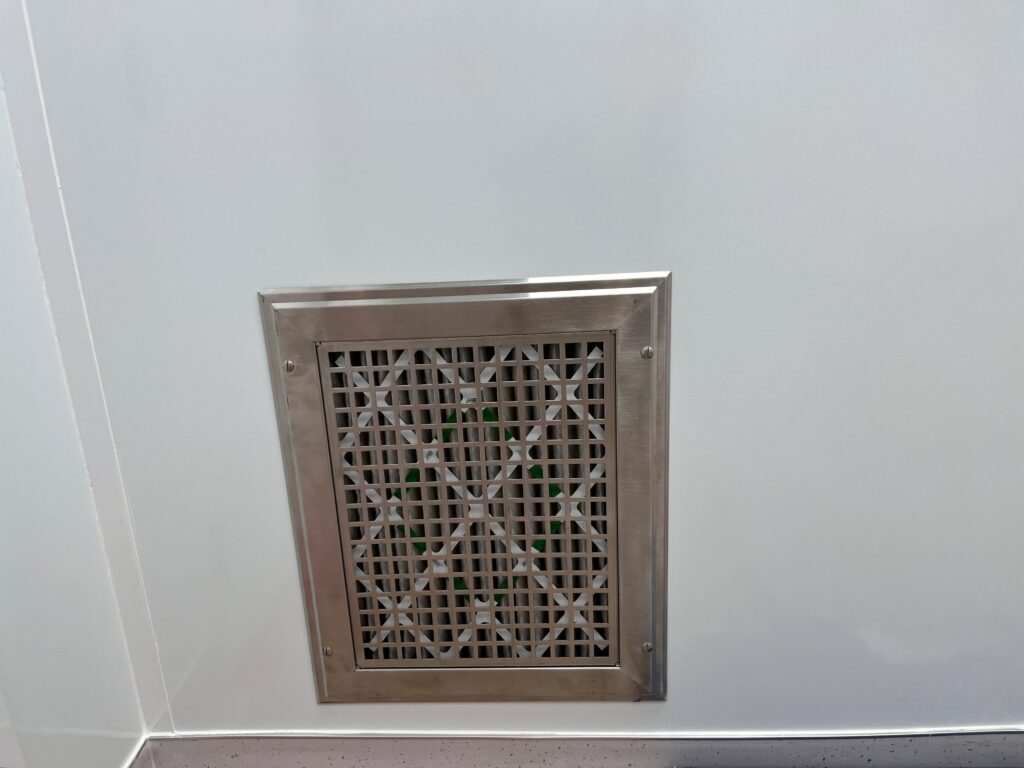
These cleanrooms also have unique airflow requirements. Unlike ISO 6 cleanrooms and above, they require unidirectional (laminar) airflow, at least to some degree.
The velocity of the air is also important, and is usually between 0.3 m/s and 0.5 m/s. This air flows down towards air returns in the walls or the floor.
Air Changes Per Hour
Additionally, they require about 240–600 air changes per hour (ACPH).
Based on information from The Engineering Toolbox, homes typically experience one or two ACPH. By a conservative measure, the air in ISO 5 cleanrooms is over 120 times fresher than that of an average home. The high number of air changes is necessary to maintain the strict ISO particle limits.
Ceiling Coverage
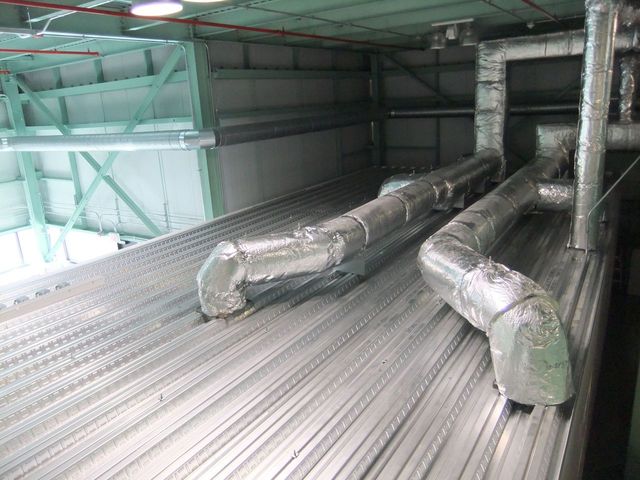
Ceiling coverage is another important requirement to consider. ISO Class 5 cleanrooms must have a ceiling coverage of around 35–75%. This simply means that a large percentage of the ceiling must have fan filter units that blow clean and filtered air into the environment.
Filtration
Additionally, they will make use of either high-efficiency particulate air (HEPA) or ultra-low particulate air (ULPA) filters.
HEPA filters can capture at least 99.97% of particles at their most penetrating particle size (MPPS), which is around 0.3 micrometers, and ULPA filters can capture at least 99.999% of particles at their MPPS, which is around 0.12 micrometers.
An ISO 5 cleanroom may use either, depending on what the cleanroom is used for. If it uses HEPA filtration only, it may need to cover the entire ceiling with them (100% ceiling coverage) to meet the standards.
Notice that ULPA filters target much smaller particles, so these will need to be used in applications where even the smallest particles can cause damage to processes or products.
ISO 5 Cleanroom Applications
To find out what classificaiton of cleanroom you need, you often start out by asking yourself what sized particles may cause issues with your proucts or processes. In industries where smaller particles are a concern, ISO 5 cleanrooms help to eliminate them. Here are some examples of industries that them:
- Electronics manufacturing
- Food manufacturing (aseptic processing)
- Biotechnology
- Pharmaceutical industry (filling rooms)
- Film manufacturing
- Aerospace
- Solar
- Nanotechnology
- Semiconductor manufacturing (wafer chips, photolithography)
- Cleantech manufacturing
- Medical devices
- Electric vehicle manufacturing (lithium-ion batteries)
Customizing Your ISO 5 Cleanroom
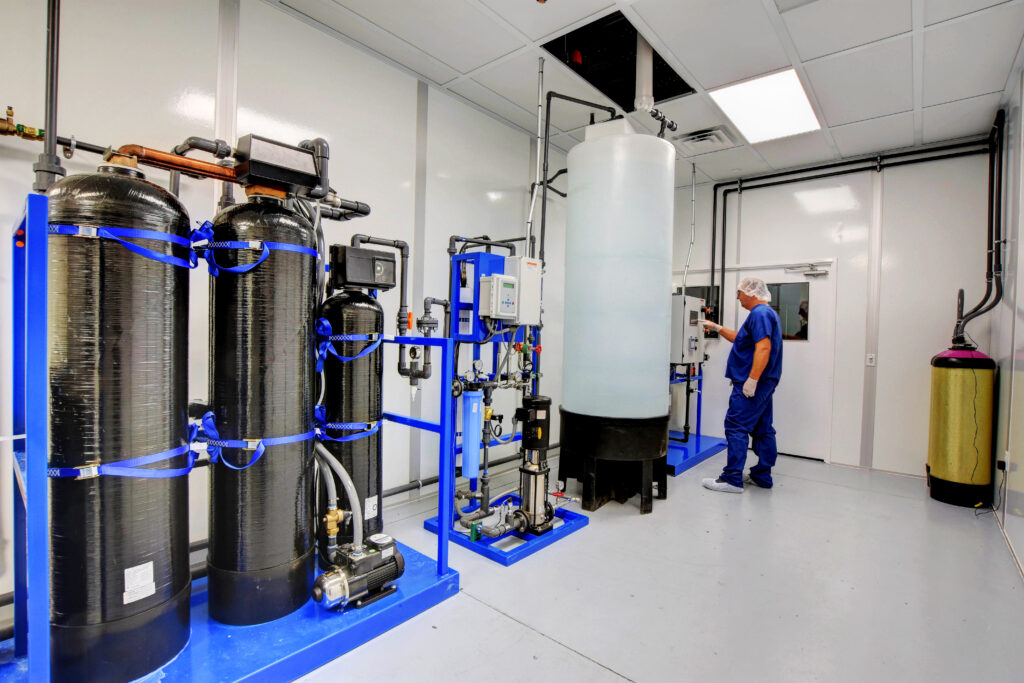
Each cleanroom will be different, and even ones of the same classification. That’s why it’s always important to customize ISO 5 cleanrooms to meet your specific requirements. This means selecting the proper materials, layout, and HVAC system.
Testing and Certification for ISO 5 Cleanrooms
ISO 5 cleanrooms are tested after construction to confirm that they meet the right specifications. For ISO 5–1 environments, semi-annual tests are necessary for particle counts, airflow, and air pressure differences, using the methods detailed in the ISO 14644-1 standard, specifically Annexes B4 (airflow), B5 (air pressure), and A (particle counts).
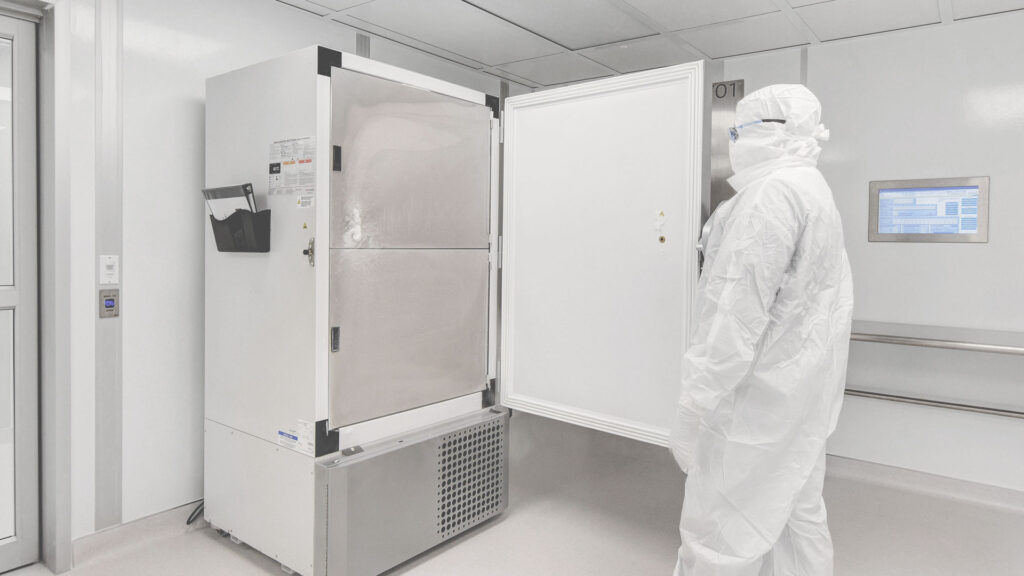
In addition to semi-annual testing, there are optional tests recommended every two years. These are tests for filter leakage, containment leakage, air recovery, and airflow visualization. Each of these tests follow specific procedures outlined in ISO 14644-1 Annexes B6, B4, B13, and B7, respectively. Such tests are designed to ensure that ISO 5 cleanrooms continue to perform well.
Why ISO 5 Cleanrooms Matter
ISO 5 cleanrooms play an important role in many industries, such as electronics and medicine, by keeping out microscopic particles that harm products and disrupt technical processes. As technologies advance and components get smaller, the need for such clean environments grows, which is why the global cleanroom market is expected to increase from $7.26 billion in 2024 to $9.5 billion by 2028.
The continuing growth of cleanroom environments shows how important they are to the products of today, and as we make new discoveries and create smaller and smaller components, they are sure to become even more relevant.
FAQs About ISO 5 Cleanrooms
Do ISO 5 cleanrooms require special clothing?
Generally speaking, yes. People working inside the space typically have to wear cleanroom PPE such as hoods, coveralls, gloves, masks, and shoe covers, among other items.
How much does an ISO 5 cleanroom cost?
The prices for cleanrooms can vary widely. A general rule of thumb for cleanroom costs is that they range from $100 to $1,000 per square foot. Given that an ISO 5 cleanroom is on the strict end of classifications, you will see costs per square foot in the upper range. Of course, the final costs depend on what features you need and how complex the space is.
Does an ISO 5 cleanroom control temperature and humidity?
Yes, they almost always control temperature and humidity. Though ISO standards focus on particle levels, as this is what makes a cleanroom a cleanroom, most if not all ISO 5 spaces will have to place temperature and humidity within certain ranges to protect products or processes, as well as make the space comfortable for workers.