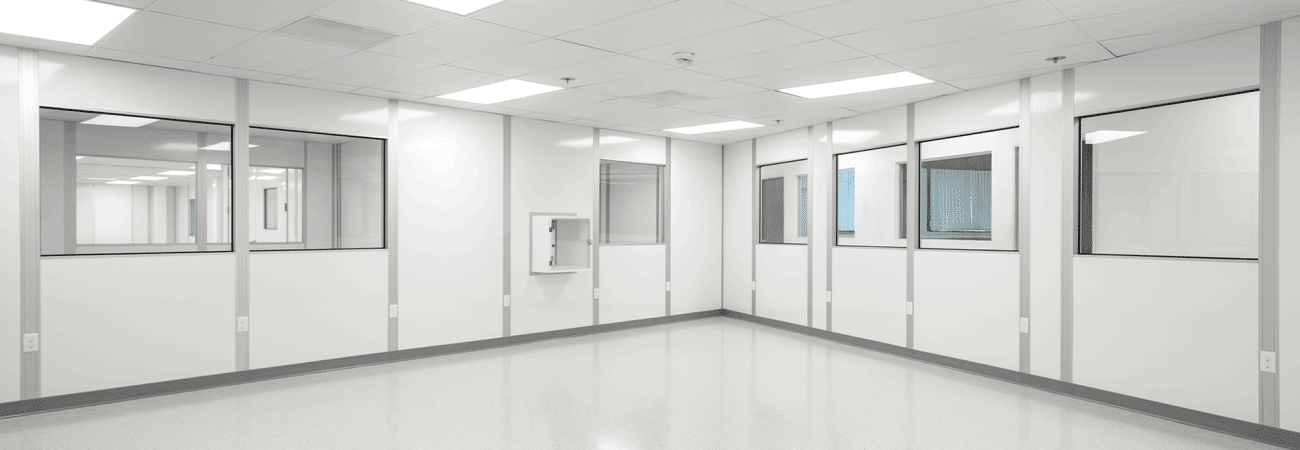
Building a cleanroom is one thing, but proving it works is a different story. In this article, we’ll cover what cleanroom validation is, the main qualification stages, what gets tested, and more.
What Is Cleanroom Validation?
Simply put, cleanroom validation is the process of confirming that a cleanroom performs as intended. Specifically, it verifies that the cleanroom, its systems/protocols, and its equipment each meet the standards required, whether that’s for ISO 14644, USP 797/800, cGMP, or other guidelines.
The terms “validation” and “certification” are often used together, despite being different, which tends to cause some confusion.
The easiest way to think about it is that validation is the process and certification is the result.
In other words, once a cleanroom has been validated and passes the required tests, it receives certification confirming that it meets the relevant standards.
The Qualification Stages

Validation follows a sequence of stages, known in the industry as DQ, IQ, OQ, and PQ. These are called qualification stages, where each one builds upon the last.
Design Qualification (DQ) is the starting point. The purpose is just what it sounds like, to prove that the design is appropriate for its intended use. This means confirming that the layout, materials, HVAC system, and filtration systems will be able to meet the target standards.
Installation Qualification (IQ), in turn, comes after the cleanroom has been built. The purpose of this stage is to verify that everything has been installed correctly, like HVAC systems, filters, flooring, monitoring systems, and other elements. In this stage, no equipment is running yet, and no personnel are present. This is also known as the “as built” state.
Operational Qualification (OQ) happens once equipment is installed, but before it is operating (and with no personnel in the room). This is also called the “at rest” state. Testing at this stage confirms that the systems work correctly. The name can appear confusing, as it is sometimes assumed that the validation occurs when the room is in operation. But instead, it essentially answers the question, “is this room ready to operate?”
Performance Qualification (PQ) is the final stage, and the most demanding. Testing is performed under real operating conditions, with equipment running and personnel present, working as they normally would. This is the “in operation” state. If the cleanroom passes PQ, it has proven that it can hold up under real conditions.
What Gets Tested?
Across the qualification stages, many tests are performed to verify that the cleanroom is working as it should. Some of the most common include:
- Airborne particle counts
- HEPA/ULPA filter integrity
- Airflow velocity and volume
- Air changes per hour
- Pressure differentials between rooms
- Temperature and humidity
- Smoke studies / airflow visualization
- Room recovery testing
The exact tests required will depend on the cleanroom’s classification, the industry it operates in, and any additional guidelines that apply, such as USP 797/800 for pharmaceuticals or ASTM standards for aerospace.
Who Performs Validation?
In most cases, cleanroom validation is performed by a third-party validation agency, not the manufacturer who built the cleanroom. Third-party validation matters because it provides independent verification. Regulators and auditors give more weight to results that come from an outside party with no stake in the outcome.
Validation also isn’t a one-time thing. ISO 14644-2 sets the framework for ongoing testing and revalidation, and specifies maximum intervals between particle concentration tests:
These are maximum intervals, and some industries require more frequent testing.
Revalidation is also required any time there is a significant change to the cleanroom, such as a renovation, new equipment, or a layout reconfiguration. Even something as routine as a HEPA filter replacement requires follow-up testing to verify the new filter is performing correctly.
The Bottom Line
Validation is what separates a cleanroom that looks ready from one that actually is. If you’re planning a new cleanroom or need help understanding what’s involved, Allied Cleanrooms has over 30 years of experience building spaces that are designed to validate cleanly from the start.