You often hear it said that filters (HEPA/ULPA) are the “backbone” of cleanrooms. This isn’t necessarily wrong. However, filters on their own can only do so much.
Even with the best filters in the world, if the air inside your cleanroom flows from a “dirtier” space into a cleaner one, particles will eventually find their way inside.
The way you prevent this from happening is to make sure that air is always pushing outward from your cleanest rooms into the dirtier rooms, and not the other way around.
This is called a pressure cascade.
It’s not the most common topic in cleanroom design, but it’s still one of the most important.
In this article, we’ll cover what a pressure cascade is, how they work, what pressure differentials to expect, and more.
What Is a Cleanroom Pressure Cascade?

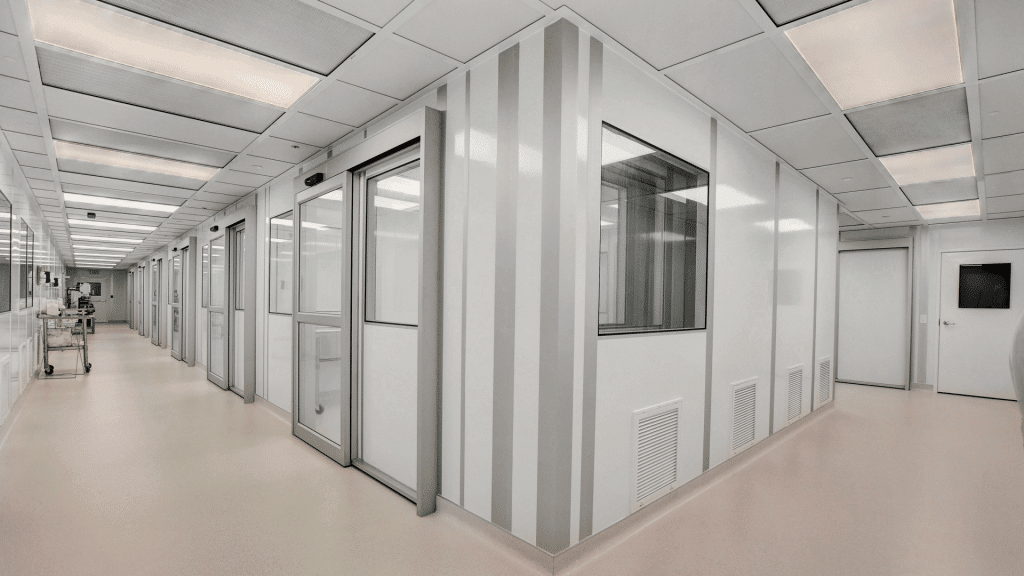
A cleanroom pressure cascade is a system where connected rooms are each held at a different air pressure. The cleanest room, naturally, will have the highest pressure so that particles are pushed out, while each adjacent room is set a little bit lower.
This creates a stepping-down pattern, a “cascade” across the entire cleanroom suite, where pressure decreases as you move further from the most important space.
The air always moves outward, from the cleanest room to the less clean ones around it. If somebody opens a door between two rooms, air blows out of the room with more pressure.
Here’s an example.
Say you’ve got a corridor that’s not controlled at all. Next to that, a gowning room. Then an ISO 8 space, an ISO 7 next to it, and an ISO 6 right in the middle. That ISO 6 room should have the highest pressure in the whole suite. Each room should step down as you move further out, and the air should move in one direction.
Why Cleanroom Pressure Cascades Matter
It may seem obvious, but if you’re running important processes where contamination could cause catastrophic consequences (like ruin a batch or create safety issues), then you cannot do without pressure control.
As we’ve discussed already, a pressure cascade keeps particles out of the most sensitive areas. When doors open or when seals are not perfect, particles have chances to enter; with higher pressure, air is pushed outward and acts as a barrier against contamination.
What’s more, it separates activities that shouldn’t mix. Your gowning room, your staging area, and your production space may all have different profiles. Pressure differentials help keep those profiles from bleeding into one another.
How It Works
At a mechanical level, a pressure cascade comes down to controlling the balance between air coming in and air going out. Engineers design the HVAC system so that each room receives a carefully calibrated amount of supply air and exhaust.
Supply air enters through ceiling diffusers or fan filter units. The more supply air a room gets, the higher its pressure climbs.
Return and exhaust air, on the other hand, leaves through grilles or exhaust systems. If you’re pulling more air out than you’re putting in, pressure drops, and that’s exactly what you don’t want to have happen in your cleanest room.
The balance between those two is what creates the pressure differential. To keep a room at positive pressure, you supply slightly more air than you remove. That excess air has to go somewhere, so it escapes through door gaps, openings, or return paths into lower-pressure spaces.
Positive Pressure, Negative Pressure, and the Cascade
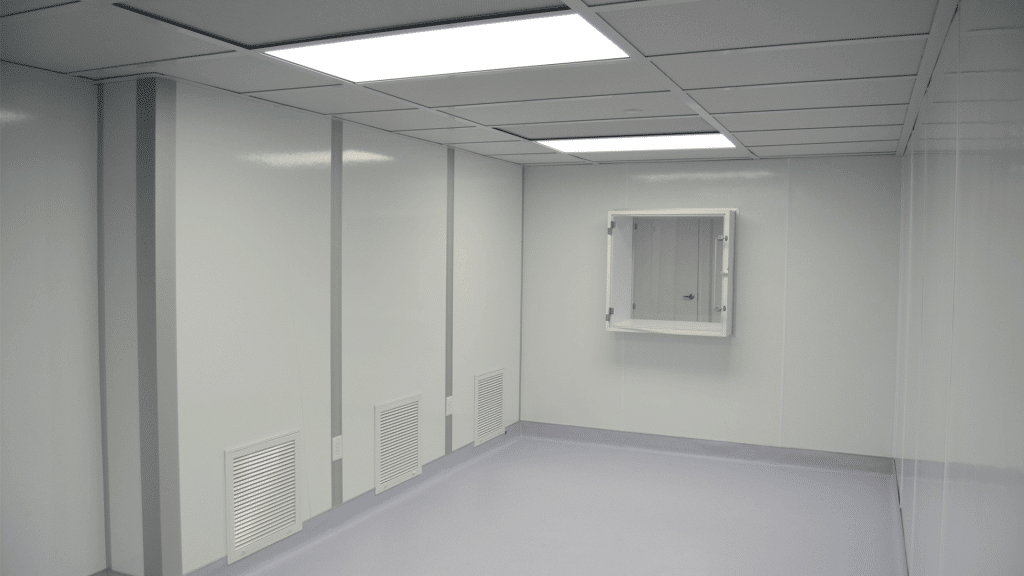
We’ve mentioned “positive pressure” already, and if you’ve spent any time looking into cleanroom design, you’ve probably come across “negative pressure” as well.
These concepts are closely related to how a cascade works, so let’s go through each one.
Positive pressure means the room’s pressure is higher than the space around it. The air pushes out.
Negative pressure is just the opposite. The room is held at lower pressure than the surrounding space, which pulls air inward. This contains whatever is inside the room. It’s used in situations where you’re working with hazardous drugs or anything you don’t want escaping into the rest of the facility.
A pressure cascade layers multiple rooms together, each at a different pressure level. Most of the rooms operate under positive pressure, but each one sits at a slightly different setpoint. The cascade guides airflow across the entire suite, from cleanest to least controlled.
What Pressure Differentials Are Typical?
It’s difficult to put an exact number on this, even though this question does come up a lot. That being said, most spaces maintain a room-to-room pressure difference somewhere between 0.02 and 0.05 inches of water column (in. w.c.).
Where you land within that range will depend on factors like your cleanliness requirements, the size and layout of your rooms, how frequently doors open between spaces, and whether your equipment generates heat that requires additional cooling airflow.
Because of all these variables, engineers typically work out the specific differentials during the design phase rather than applying a single standard number.
Which Industries Use Pressure Cascades?
Pressure cascades are common across most industries that operate multi-room cleanroom suites. Some of the most common include:
- Pharmaceuticals
- Medical devices
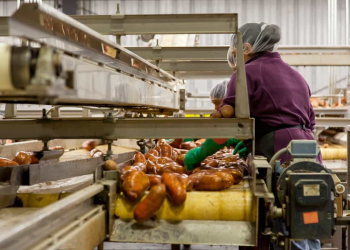
- Semiconductors and electronics
- Life sciences and research laboratories
The Bottom Line
A pressure cascade is one of the most important parts of cleanroom design. By keeping your cleanest rooms at the highest pressure and stepping down from there, you ensure that air always flows in the right direction, away from your critical areas and processes