Needless to say, a lot of thought goes into cleanroom walls, ceilings, and especially filters.
But doors ought to receive just as much attention, since they make up the one part of the wall that’s supposed to open. And every time they do open, the room is exposed to whatever is on the other side.
In this article, we’ll cover why cleanroom doors are important, the most common types, what makes them different from ordinary doors, and how to choose the right one for your space.
Why Cleanroom Doors Matter
Most cleanrooms are kept at a slightly higher pressure than the rooms around them, so that air flows outward and particles can’t drift in. (Some work the other way around, but the idea is the same.)
Doors are where that pressure gets put to the test. When one opens, air moves through the gap, and the pressure difference between the two rooms can drop, or even reverse for a moment.
The longer the door stays open, and the more often it’s used, the more chances particles have to get through.
A door doesn’t have to be open to cause trouble, though. If it doesn’t seal well and leaks, then your HVAC system may have to work harder to make up the difference.
Common Types of Cleanroom Doors
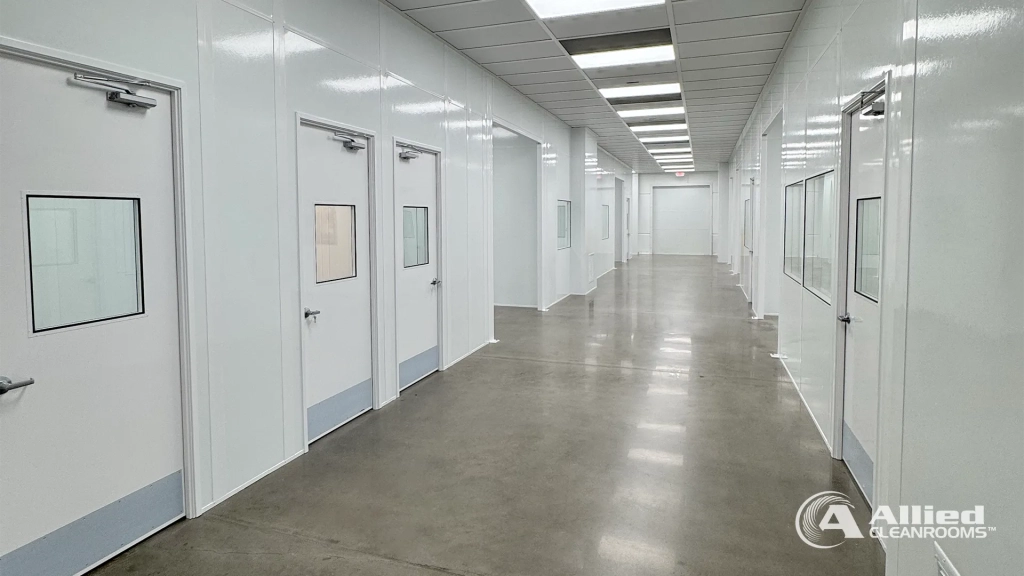
There are a handful of door types in cleanrooms, and it’s not uncommon for a cleanroom to end up with a mix of them.
Swing doors. These are the standard choice. They can come as single or double doors, generally seal better than sliding or roll-up doors, and usually cost the least. The downside is that they require sufficient space to swing.
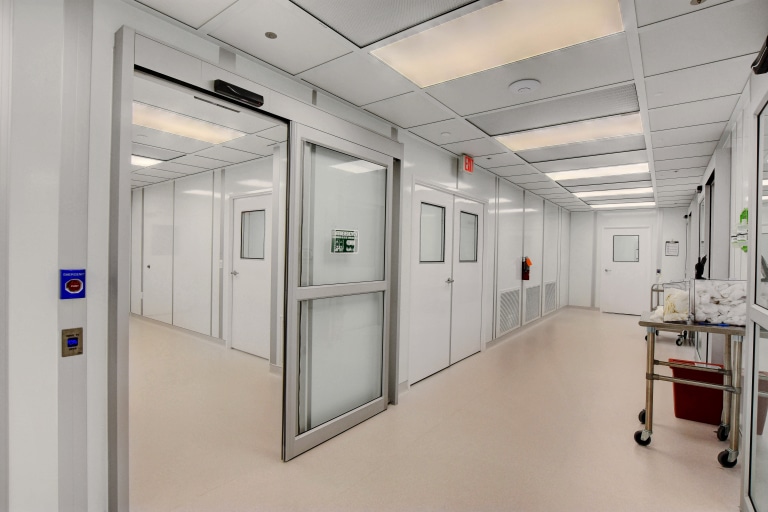
Sliding doors. These move along a track, so they don’t take up any extra floor space when they open. As a result, they’re especially useful in tight/smaller layouts or busy areas, though they generally don’t seal as tight as a swing door.
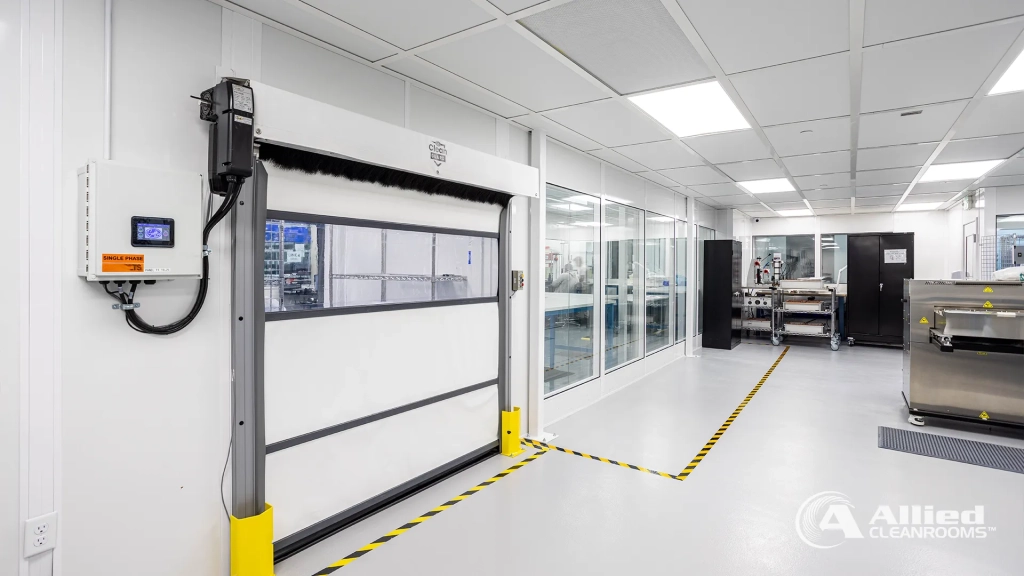
Roll-up doors. These are useful when materials on carts or pallets have to get in and out; that is, when certain items or equipment need more space to enter. Roll-up doors open upward, and the high-speed versions open and close in seconds, so the opening is exposed for as little time as possible.
Strip curtains. Softwall cleanrooms often nix doors altogether and use overlapping vinyl strips at the entrance. They’re cheap and easy to walk through, but they’re generally used in the less strict classes, like ISO 7 or ISO 8.
You may also hear about hermetic doors, which press against a gasket to form an airtight seal. Those are reserved for the strictest spaces and for containment work.
It should be said that most of these doors also come in either manual or motorized versions.
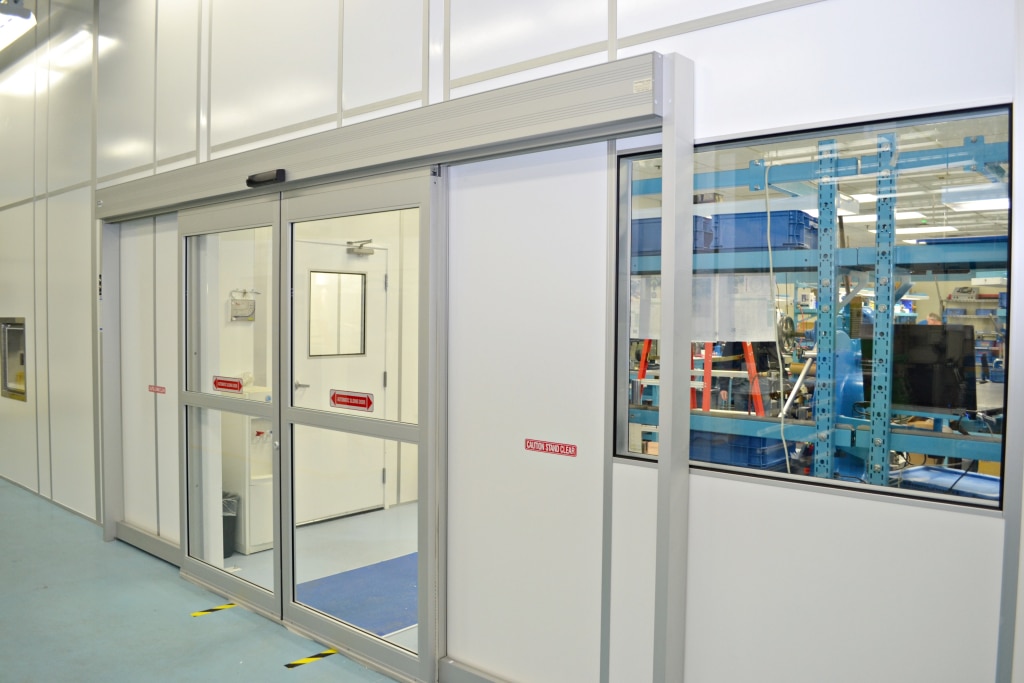
Motorized doors open with a motion sensor or a touch pad, so workers don’t have to grab a handle with gloved hands, which is useful in busy areas or when someone’s hands are full.
The trade-off is in their cost, and perhaps also the fact that you’ll need a backup plan if the power goes out.
What Makes a Door Suitable for a Cleanroom?
Unfortunately, ordinary doors have plenty of places for particles to hide, especially when you consider things like raised panels, exposed hinges, window frames, or the gap at the bottom.
Cleanroom doors are made to minimize such space where particles can come in and linger. Ideally, there should be no ledges for dust to settle on, and nothing too difficult to wipe around.
They’re also, as you might expect, sealed on every side. Gaskets run around the frame, and many doors have a seal that drops down to close the gap at the floor when the door shuts.
As far as materials go, aluminum, stainless steel, and FRP are all common, because they don’t shed and they can take repeated cleaning with disinfectants.
Interlocks and Swing Direction
But even a well-sealed door can only do so much on its own. How it’s installed, and how it works with the doors around it, is equally important.
Take interlocks, for example. An airlock or gowning room typically has two doors, one leading in from the outside and one leading into the cleanroom. An interlock links them so that only one can be open at a time.
If both were open at once, there would be a straight path from the outside right into your cleanroom.
Then there’s also the matter of where the door swings (the direction). As a general rule, a swing door should open into the room with the higher pressure.
That way, the pressure itself pushes the door shut against its seals.
How to Choose Cleanroom Doors
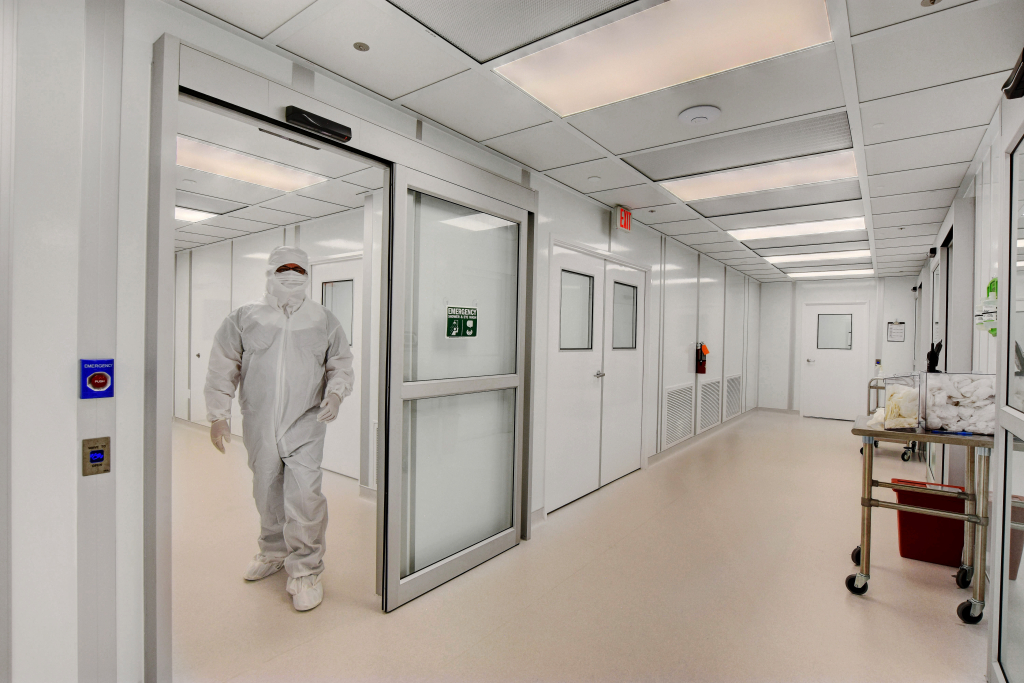
Choosing the right doors for your cleanroom will ultimately depend on what is passing through it and how often.
For people, a swing door is usually enough. For carts and equipment, you’ll probably want double doors or a roll-up door, and if floor space is tight, a sliding door may be worth the trade-off.
Your ISO class and pressure requirements are relevant as well, since stricter rooms need tighter seals.
Don’t forget about the rules that have nothing to do with cleanliness, either, like fire codes and ADA access.
Whatever you choose, it helps to decide early. Doors can affect the layout, pressure cascades, and how people and materials move through the space, so they’re much easier to plan for at the design stage than to change later.