Defense and military cleanrooms are some of the most compliance-heavy environments that exist. The reason for this is that the stakes are much higher. If a few particles find themselves in a piece of equipment, it could cause catastrophic failures. In this article, we’ll cover what makes them different from other kinds of cleanrooms, the standards they must meet, and what to think about when designing one.
What Makes a Defense and Military Cleanroom Different?
At first glance, a typical defense/military cleanroom may look similar to ones used in semiconductor or pharmaceutical manufacturing. But there are a few important differences.
For one, work is often highly classified. Within defense programs, engineers, contractors, and others are often not able to disclose what’s being built. If you’re in charge of designing the cleanroom, it’s obviously very difficult to figure out what kind of space to create when you’re not allowed to know what’s going on inside.
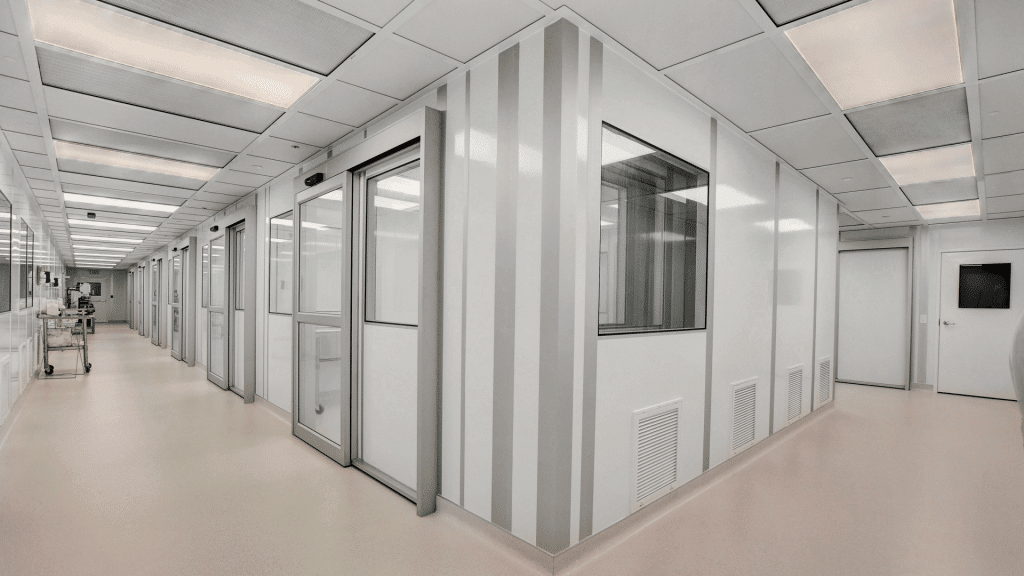
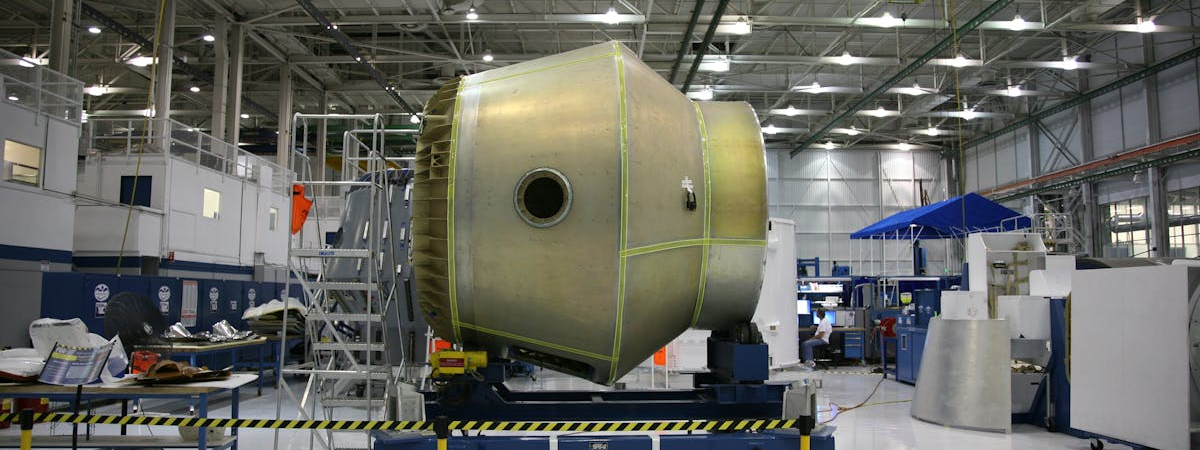
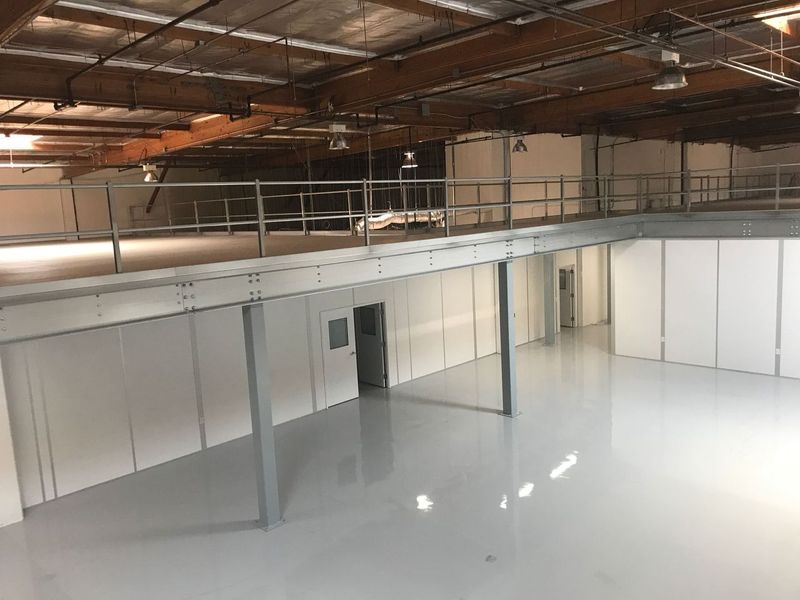
Also, defense and military hardware is physically large in general. Think about satellite payloads, aircraft engines, and missile systems that need vast amounts of space just to be assembled. As a result, in many cases these cleanrooms need to be wide and column-free. Modular construction can typically achieve clear spans of 20 feet or more, which makes it a natural fit for this kind of work.
Defense and military cleanrooms also often need to serve more than one purpose. For instance, a space that’s used for manufacturing during one phase may need to function as a testing environment during another.
When the work changes, the required ISO classification often changes with it, which means the room needs to be able to adapt (and this is why modular cleanrooms are such an advantage for this industry).
Important Standards for Defense and Military Cleanrooms
In defense and military applications, regulations are heavy, to say the least. Many standards, in fact, are layered on top of one another. Here are a few of the most common ones:
- ISO 14644: This is the universal starting point and current international standard for cleanrooms. Most importantly, ISO 14644 defines the classification system based on air cleanliness, but also covers how monitoring and testing should be carried out.
- ASTM E2217: This standard covers the design and construction of aerospace cleanrooms and contamination-controlled areas. If you’re planning to build a defense cleanroom, ASTM E2217 is the most directly relevant ASTM standard.
- ASTM E2352: These guidelines are more geared towards the operational side, and cover gowning, personnel behavior, cleaning methods, and surface handling.
- IEST-STD-CC1246E: Current standard for product cleanliness levels and contamination control in defense and aerospace programs. It has replaced MIL-STD-1246C and governs how clean your hardware needs to be.
- AS9100D: A quality management system standard. It builds on ISO 9001 and adds requirements for risk management, configuration control, and counterfeit part prevention.
- NASA requirements: NASA has several standards that may apply depending on the program.
Common Defense and Military Cleanroom Applications

Defense cleanrooms are used across a wide range of applications, each with its own cleanliness requirements. Here are some of the most common:
- Missile guidance and laser targeting systems (ISO 5–6)
- Defense electronics and microchip fabrication (ISO 5–6)
- Radar and avionics assembly (ISO 6–7)
- Satellite payloads (ISO 5–6)
- Optical and sensor systems (ISO 5)
- Drone and UAV parts (typically ISO 7)
- Aircraft engine assembly (ISO 8)
Important Design Considerations
Defense and military cleanrooms have specific design needs that go beyond what a standard cleanroom requires. Here are the most important ones to address early.
- Clear Spans: We mentioned this earlier, but large hardware requires a lot of open space. As a result, these cleanrooms frequently need column-free spaces of 20 feet or more.
- ESD-Safe Flooring & Non-Outgassing Materials: The wrong flooring can allow static electricity to build up and damage electrical parts. Similarly, materials that outgas can fog optics or damage sensitive parts over time.
- Reconfigurability: Defense programs often change, so a cleanroom that works for ISO 7 prototype assembly today may need to reach ISO 6 for final integration tomorrow.
- Environmental Monitoring: It’s also best if these spaces have real-time tracking of particle counts, pressure, temperature, humidity, and other required conditions; with this technology, deviations in conditions can be quickly addressed.
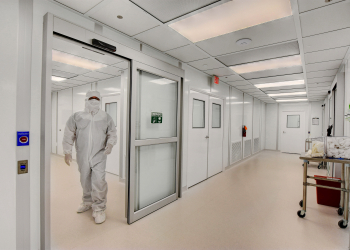
- Personnel Flow & Gowning Areas: Defense cleanrooms often need to manage both contamination control and security access at the same time, which means the layout needs to be thought through carefully.
Why Modular Construction Works Well for the Defense Industry
If we’re being honest, traditional stick-built construction does have its place in some applications, but defense cleanrooms may be a poor fit for it. Here are a few reasons why modular tends to work better.
Defense programs, of course, are run on tight schedules. Because modular cleanrooms are manufactured off-site and installed quickly, there’s less room for things to go wrong, and not much disruption on site, either.
Furthermore, modular construction comes with fixed upfront costs (at Allied Cleanrooms, we are against change orders), which makes it easier to plan and harder for overruns to creep in.
Perhaps the biggest benefit of modular cleanrooms is that they can be upgraded, say, from an ISO 7 to an ISO 6, without needing to tear down and rebuild the structure.
What’s more, modular systems can be added to, downsized, and even relocated if need be. It goes without saying that this kind of flexibility is impossible with traditional construction.
Finally, for government-funded projects, Allied Cleanrooms holds a GSA contract, which simplifies and speeds up the procurement process.
The Bottom Line
Defense and military cleanrooms can be complicated, especially when having to meet layers of compliance. But with the right design and the right manufacturer, they don’t have to be. If you’re planning one, Allied Cleanrooms has over 30 years of experience and a GSA contract for government-funded projects. Contact us today for a free quote.